This is a website created with the intention of pointing unbelieving people in the direction of Jesus Christ, and giving proper material to believers, both young and old, for the purpose of equipping them to grow in their faith and to help them effectively reach those around them for God's Kingdom.
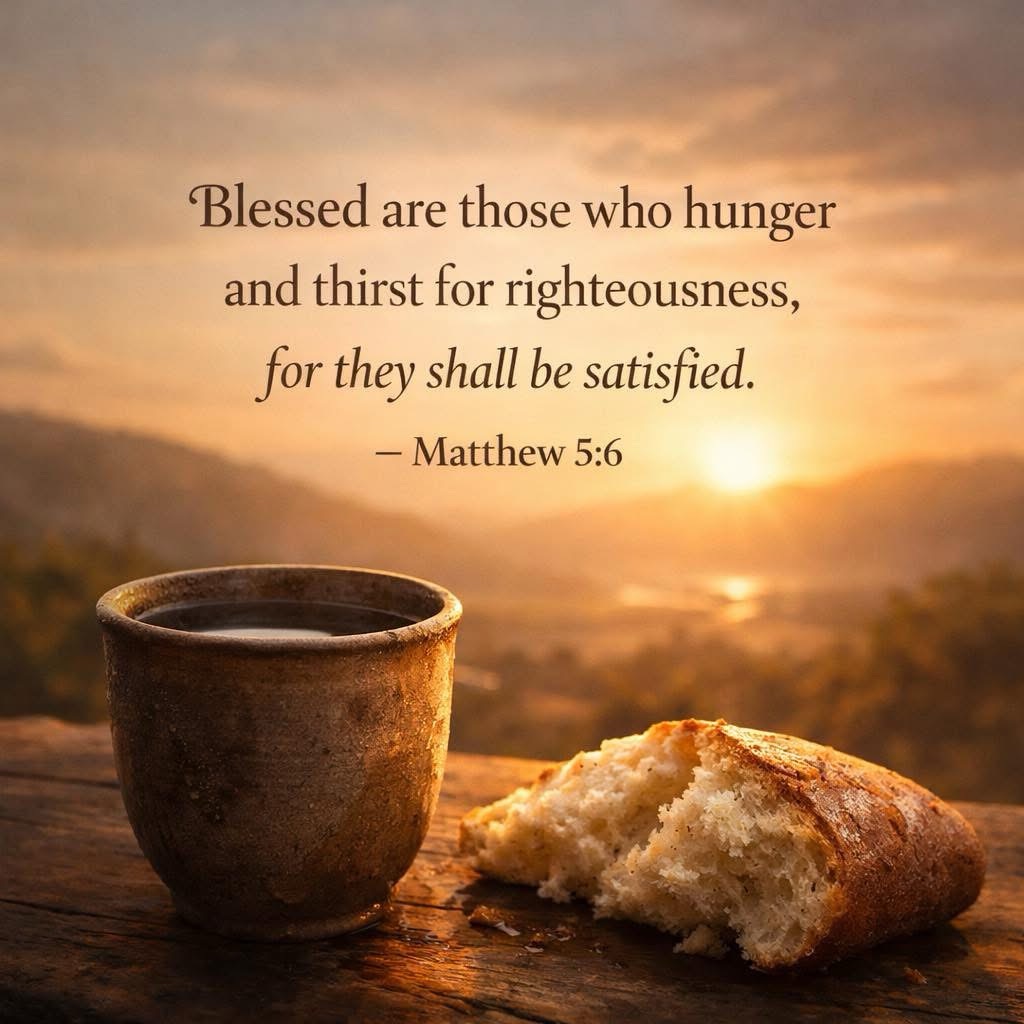
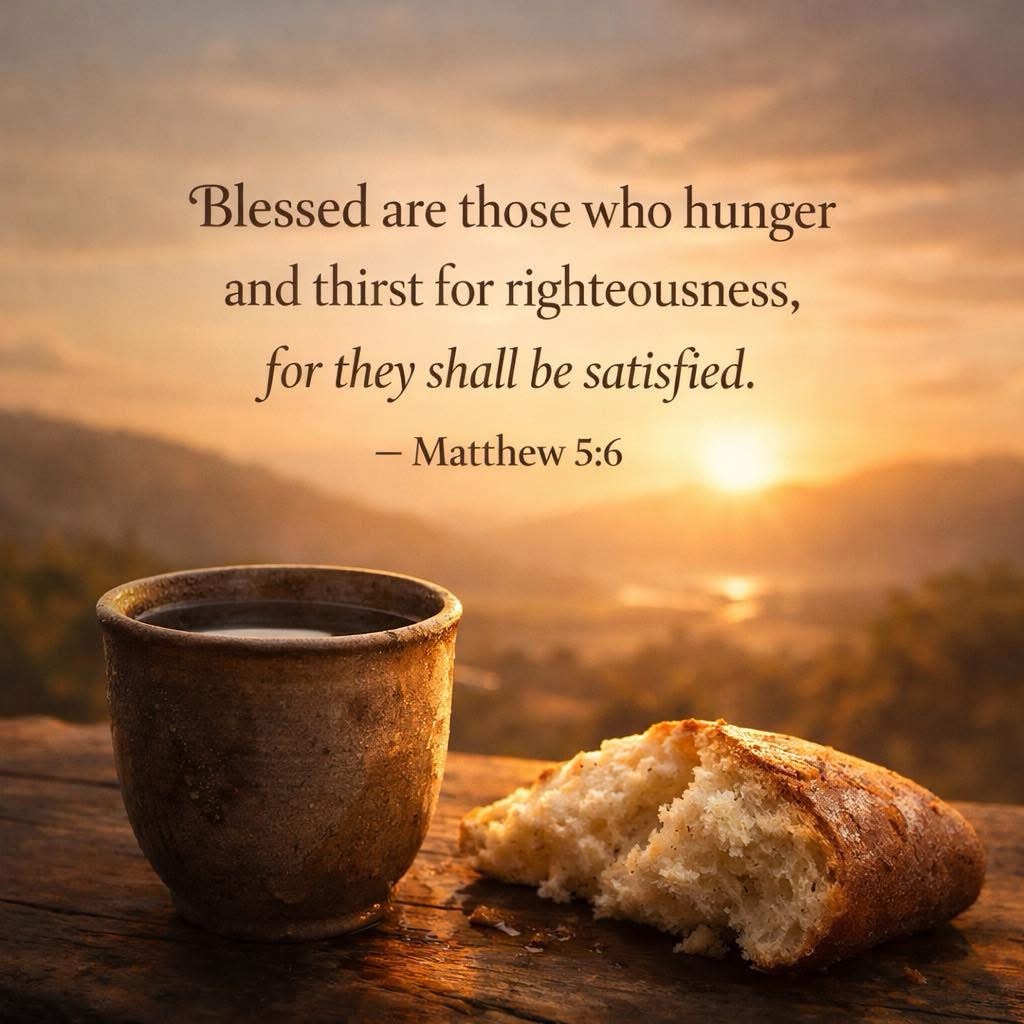
As many of you may know I’ve been reflecting on the Beattitudes from Jesus’s Sermon on the Mount! Today i’m reflecting on Matthew 5:6, and considering current events I believe this is timely. Matthew 5:6 says, “Blessed are those who hunger and thirst for righteousness, for they shall be satisfied.” After poverty of spirit humbles us, after mourning opens us up, and after meekness reshapes how we walk, Jesus now turns to desire. What do we actually want?
Hunger and thirst are not casual interests. They are not polite preferences. They are signals of need. When you are truly hungry or truly thirsty, everything else becomes secondary because that need is a matter of continued life. When someone is hungry or thirsty, comfort, convenience, and even dignity take a back seat to survival. Jesus chooses that language intentionally here. He’s not talking about people who admire righteousness or agree with it in theory. He’s blessing those who feel its absence so deeply that they ache for it.
And this hunger doesn’t appear out of nowhere. It’s the natural result of the first three Beatitudes. When you know you’re poor in spirit, you stop pretending you’re fine. When you mourn honestly, you stop numbing the pain. When you walk in meekness, you stop demanding your own way. And once all that is stripped away, something new rises up: a longing for what is truly right, truly good, truly aligned with God.
Righteousness here isn’t merely about moral behavior. It’s about rightness with God and rightness in the world He created. It’s a longing for justice where there is injustice, truth where there is distortion, holiness where sin has left things broken. It’s the ache that says, “This isn’t how things are supposed to be,” and the faith that believes God can make it right.
But there’s something important we can’t miss. Jesus doesn’t say the hungry and thirsty will achieve righteousness. He says they will be satisfied. That matters. Hunger implies dependence. Thirst admits a great need. I must make this clear: This isn’t self-made righteousness or spiritual performance. It’s the posture of someone who knows they cannot produce what they need, but trusts God to provide it.
And God does. Ultimately, He satisfies this hunger in Christ. Jesus is our righteousness! He lived the life we couldn’t live and gives us a righteousness we didn’t earn. But He doesn’t stop there. He continues to shape us, to grow us, to align our hearts with His; enabling us to live in such a way that is congruent with how he lived. In other words, the hunger remains, but it’s no longer empty. It’s met with grace, truth, and transformation.
The promise is sure: those who hunger and thirst for righteousness will not be left starving. God doesn’t tease His people with desires He refuses to fulfill. If you find yourself longing for holiness, for justice, for God’s will to be done in your life and in this world, that hunger itself is a sign of grace. And Jesus says you are blessed, because satisfaction is coming. And THAT is good news!
“Blessed are the meek, for they shall inherit the earth.” (Matthew 5:5)
I’ve had to wrestle with this verse this week, because, in my flesh, I have a lot of reasons not to choose meekness. But Jesus talks about meekness, and blesses the meek. And this is important: He’s not praising passivity or a lack of conviction. In Scripture, meekness is about gentleness and humility, especially in how we relate to God and to others. It’s the posture of someone who doesn’t feel the need to be harsh, domineering, or reactive. Jesus Himself describes His own heart this way: “I am gentle and lowly in heart” (Matthew 11:29). Meekness grows out of trusting God enough to live without posturing or self-promotion.
This fits naturally with the flow of the Beatitudes. “Blessed are the poor in spirit, for theirs is the kingdom of heaven” (Matthew 5:3) reminds us that we begin by recognizing our dependence on God. “Blessed are those who mourn, for they shall be comforted” (Matthew 5:4) shows us what happens when we bring that reality honestly before Him. Meekness is what that inward posture starts to look like on the outside. Humility before God slowly shapes gentleness toward people.
That doesn’t mean meek people are inactive or silent. Scripture never presents meekness that way. Moses is called “very meek, more than all people who were on the face of the earth” (Numbers 12:3), yet he confronted Pharaoh and led Israel with courage. Meekness doesn’t remove strength or conviction. It shapes the way they are expressed. Paul expresses this concept when he urges believers to speak “the truth in love” (Ephesians 4:15)
Jesus gives us a very clear picture of this posture in the Garden of Gethsemane. On the night before the cross, He prays honestly, “My Father, if it be possible, let this cup pass from me,” and then submits fully, saying, “Nevertheless, not as I will, but as you will” (Matthew 26:39). Jesus is neither resentful nor resistant. He entrusts Himself to the Father with humility and obedience, embodying gentleness even in the face of suffering (Hebrews 5:7–8).
And finally, we need to remember that Jesus attaches a promise: “the meek shall inherit the earth” (Matthew 5:5), echoing Psalm 37:11. Inheritance in this case isn’t seized or demanded. It’s received from God. The meek are willing to walk humbly and respond gently, trusting that God is faithful with what comes next. And Jesus says that kind of life, shaped by humility and gentleness, is blessed. It reminds me of Micah 6:8, and I think we all ought to consider living by this standard: “He has shown you, O mortal, what is good. And what does the LORD require of you? To act justly and to love mercy and to walk humbly with your God.” May we do this very thing!
For the longest time, I would say to myself, “If anything is gonna get done, I’ve gotta do it myself.”
At first, it wasn’t a bad thing. When I was younger, working early mornings and dragging myself out of bed at 5 AM, that phrase was a pep talk. It was how I motivated myself to work hard, to show up, to not quit when it was uncomfortable. In those early years, it felt like discipline.
But over time, that same statement slowly changed. What started as motivation turned into cynicism. I began to believe it. Whether it was coworkers, co-leaders, or people close to me, I carried the quiet assumption that if something really mattered, I was on my own. I didn’t just work hard, I carried everything. And eventually, that mindset nearly broke me. I came dangerously close to burning myself out, emotionally, spiritually, and physically.
That’s why Matthew 5:3 still convicts me deeply today:
“Blessed are the poor in spirit, for theirs is the kingdom of heaven.”
Jesus isn’t blessing laziness or passivity. He’s blessing those who know they are spiritually bankrupt apart from God. To be poor in spirit is to abandon the illusion of self-sufficiency. It is to stop believing that strength, effectiveness, or worth comes from our ability to carry everything ourselves. The kingdom of heaven does not belong to the spiritually impressive, the hyper-competent, or the self-reliant. It belongs to those who know they need mercy, grace, and God’s sustaining power at every level of life.
I’m slowly learning this. Slowly, but surely. I’m learning to be poor in spirit. I try to live with that reminder as often as I can, because I truly do want to inherit the kingdom. And that means resisting pride in every form. Spiritual pride. Pride in work ethic. Pride in position. Pride in achievements. Pride in finances. Pride in gifting. Pride that whispers, “I’ve got this,” when what God is inviting us to say is, “Lord, I need You.”
The kingdom doesn’t advance through people who carry everything. It advances through people who know they can’t.
Today Laurie and I met with our counselor, who has been lovingly supporting us for the past two years through so much. He pointed out some very valuable things about us that completely changed my perspective. I went into that meeting beating myself up, feeling down on myself, as if I was a worthless throwaway. I felt like someone who had failed too many times, someone who was too bruised and too broken to still be effective. But God used that time to remind me of something I had forgotten: that even when we are limping, even when we are weary, He is still using our lives to touch others in ways we often cannot see.
There’s something that has been weighing heavily on my heart for a while now, and I want to do my best to share it with honesty and humility. This is not a post meant to make anyone feel guilty or condemned. It is not a complaint. It is the story of how God met me in the darkest places and how that story has shaped the way I view ministry, the church, and what it truly means to be a shepherd.
When I was a child, I went through abuse that no child should ever experience. I will not go into the details, because those details are not the point of this post. What matters is that even in that dark and painful season, God never stopped reaching for me. There were moments when I felt completely unseen and unheard, yet in the middle of all that pain, I would have these undeniable encounters with the presence of God at the altar. I remember being at kids camp, kneeling at the front of a chapel, feeling the presence of God wrap around me like a blanket when everything else in my life felt cold and broken.
I want to say this clearly. The things that happened to me were not my parents’ fault. They did not know what had happened until many years later when I was already an adult. I love my parents deeply. But for years, I carried those scars silently. I carried them into adolescence and into adulthood. By the time I was nine years old, I was already wrestling with things I could not put words to. I struggled with symptoms that were later identified as depression, anxiety, and post-traumatic stress disorder. I did not know how to explain the storm that was happening inside of me. All I knew was that I kept going back to those altar moments because somehow that was where I felt closest to peace.
Then, when I was fifteen years old, I had another one of those powerful altar moments at youth camp. That night, as I stood with tears running down my face, I heard the voice of God speak to my heart. I felt Him call me into ministry, specifically youth ministry. The message that night felt like it was directed straight at me. The speaker talked about how God can use the broken, the hurting, and the forgotten to bring healing to others. Something inside me broke and healed all at once. I knew at that altar that my life was not my own. I knew I was called to speak life into students who were walking through the same kinds of pain I had walked through when I was young.
But the road from that altar to where I am today has not been easy. I always thought that once I entered ministry, the hard part would be over. I thought that once I became a pastor, people would finally love me the way I had longed to be loved by the church when I was younger. Looking back, I realize that was a very naive thought, but it came from a genuine place. I wanted to belong. I wanted to help others belong. What I did not expect was that some of the deepest wounds of my life would come at the hands of church people.
Over the years, I have experienced rejection, gossip, betrayal, and slander. I have had the worst lies spread about me behind closed doors… lies told when I wasn’t there to speak the truth. I have felt heartbreak inside the very walls of the church. I’ve seen how quickly people can turn on each other, sometimes even in the name of righteousness. There have been seasons when I poured my heart into people, only to be met with silence or misunderstanding. There were moments I questioned my calling altogether because of the pain that came with it. And it wasn’t just me who carried that pain. When my wife was suffering from postpartum depression, instead of love, she was met with rejection and betrayal from some of the very people who should have surrounded her with compassion. That season broke something in both of us, but it also revealed what genuine ministry should look like… not performance, but selfless, sacrificial love.
I have even had ministry leaders try to use my diagnosis of PTSD against me, as if being wounded disqualified me from ministering effectively. What they did not understand is that my scars are not a sign of weakness but of survival and redemption. My limp is not proof that I am broken beyond repair. It is proof that God has healed what should have destroyed me. Yet every time I reached the point of wanting to give up, God would remind me of that altar moment at fifteen years old. God speaks firmly to my heart, “I called you to love them anyway.”
And here is the truth I want to make sure is clear. Despite the pain I have experienced and the wounds I have carried, I hold no hatred or bitterness toward those who have hurt me. If any of those same people were to walk through my doors today, I would receive them with open arms. I would welcome them as brothers and sisters because the love that God has placed in my heart for them is deeper than the pain that was caused. The love of Christ in me outweighs the hurt that others have done to me. I choose grace because grace is what God chose for me.
Laurie and I have made it a core value of our ministry to love people deeply, even when it costs us something. We have opened our home to people who were hurting. We have stayed up late at night praying with students, feeding families who did not know how they were going to make it, and walking with people through dark and messy seasons. We have given what little we had, not because we were trying to impress anyone, but because we remember what it was like to feel unseen. We made it our mission to make people feel like family.
I have come to understand that this is what real shepherding looks like. Real pastoral leadership is not about titles or stages. It is about towels and tears. It is about walking with people when they are at their lowest. It is about staying when everyone else leaves. It is about leaving the ninety-nine to go after the one who is wandering, confused, or broken. Jesus never built a ministry around comfort. He built it around compassion.
The church was never meant to be a stage for performance but a place where love is genuine and lives are shared. Romans 12:9–10 tells us to “let love be genuine” and to “outdo one another in showing honor.” Jesus said the world would know we are His disciples by our love, not by our polish or perfection. True ministry is not about impressing people; it is about serving them. Philippians 2 reminds us to look not only to our own interests but also to the interests of others, walking in the humility of Christ. Real pastoral leadership means laying down our pride to lift others up, walking beside the hurting, and showing the kind of selfless, sacrificial love that reveals the heart of Jesus.
If I am being completely honest, ministry has been both the greatest joy and the deepest pain of my life. It has stretched me beyond what I thought I could bear. But it has also shown me the heart of God in ways that nothing else ever could. Because every time I have been hurt, every time I have been misunderstood, every time I have been tempted to close my heart, the Lord has met me again at the altar and reminded me that He was wounded by the very people He came to save. That realization changes everything. It changes the way I see those who hurt me. It changes the way I lead. It changes the way I love. Jesus never gave up on the church, even when the church was unfaithful to Him, and I refuse to give up on it either.
I also know that I haven’t done everything perfectly. In fact, I have failed often. But even in my failures, I have learned to fail forward. Proverbs 24:16 says that though a righteous man falls seven times, he rises again. That verse reminds me that grace is not just for the moments when I am strong, but for the moments when I stumble. I want to live my life humbly before the Lord… quick to repent, quick to forgive, and quick to get back up again, no matter what I experience.
At one point, I heard someone say, “I don’t trust a pastor who doesn’t walk with a limp.” That line has stayed with me ever since. It speaks to something sacred. The limp represents the encounter that leaves you forever changed, like Jacob wrestling with God. It represents the scars that remind you of where you have been and the grace that keeps you moving forward. I resonate with that deeply, because every pastor who has been through pain and still chooses love walks with a holy limp. Those who have been wounded but still show up, who have every reason to close their hearts but still open them, are the ones who reflect Jesus the most.
So to every pastor, every leader, and every believer who feels weary, please remember why you started. Remember that God called you not because you were strong, but because you were willing. You may be limping, but your limp tells a story. It tells the world that grace is real, that healing is possible, and that God is faithful even in the struggle. Do not let bitterness steal your compassion. The world does not need more guarded leaders. It needs shepherds who have wrestled with God and walked away changed. It needs pastors who walk with a limp and still keep walking.
I have seen over a hundred young people give their lives to Jesus through the ministries Laurie and I have been blessed to lead over the past 6 years. Every single one of those moments reminds me why we keep going. Every testimony, every tear, every student who finds hope again makes every wound worth it. So I will keep loving. I will keep serving. I will keep opening my life to people even when it hurts. Because I know what it is like to be the one. And I know what it is like to be found.
That is what real church should look like. That is what real pastoral leadership should look like. Not perfect, not polished, but present. A family that loves deeply, forgives freely, walks with a limp, and always points back to the altar where it all began. Where we remember how we got here. At the base of the old rugged cross. Where we may have thought we were saying yes to Jesus, but it was really Him saying yes to us. As the hymn says… “So I’ll cling to the old rugged, its shame and reproach gladly bear…” This is the life I have been called to live, and I will live this life until the day Jesus calls me home.
Every now and then, someone asks a question that deserves more than just a quick reply in a message thread. That’s exactly what happened when Ark brought up something that many people, believers and skeptics alike, have wrestled with: Is prayer actually effective? Can prayer actually lead to things like verifiable, real-world healing? In other words, is there any solid evidence that prayer does more than offer emotional comfort or spiritual encouragement? Does it actually do something?
It’s a great question, and it gets right to the heart of a much bigger conversation. In a world like ours, people want to know: If God is real and prayer works, then shouldn’t we be able to see that in a way that holds up under scrutiny? That’s not just a fair question: it’s an important one. Because if prayer is merely psychological, then we’re talking about a coping mechanism. But if prayer has real power, then we’re talking about something far more profound: evidence of divine interaction in the physical world.
That’s why I decided to answer Ark’s question here, on the site, for anyone who’s curious about this topic. These kinds of questions challenge us to think deeply, not just about prayer, but about the kind of universe we live in. Is it closed off to the supernatural? Or is it possible that the God who created the natural order steps in and does what only He can do?
In the article that follows, I explore some of the best-documented cases, clinical studies, and personal experiences that suggest prayer has, in certain instances, resulted in healing that defies natural explanation, therefore proving it has effect. But more than that, I want to invite you into the conversation. Because while questions like this matter, I believe the answers (when we’re willing to explore them) can lead us not just to information, but to transformation.
Ark’s Question:
I notice you encourage people to pray.
This aspect of Christianity has always fascinated me.
Do you have any evidence to demonstrate a single verifiable incident where intercessory prayer has been effective?
My Answer
That is a fair and thoughtful question, and I appreciate your openness in exploring this issue. When many atheists ask for “verifiable” evidence, they often imply that the proof must fit entirely within a naturalistic framework, which is one that leaves no room for supernatural intervention. In practice, this means they demand evidence that can be conclusively proven by laboratory standards, excluding any possibility of divine influence. While this is an understandably cautious stance, it also establishes a very high and, at times, shifting standard of proof that may inadvertently dismiss events that defy conventional explanations. The closest example I have that you’re looking for is directly related to physical healing, so I will focus physical healing as the overarching topic in this response.
I believe there are documented cases that merit serious consideration because they occurred in direct response to prayer. One striking example is the evidence from the Lourdes Medical Bureau, an independent, physician-led board in Lourdes, France. At this place, which is also a renowned pilgrimage site, over 7,000 healing cases have been reported, and out of these, approximately 70 have been declared medically inexplicable after exhaustive clinical review. In each of these cases, formal prayer, whether through the collective prayer of pilgrims or through intercessory prayer on behalf of individuals, preceded healings that could not be attributed to any known natural cause. These include instances such as advanced multiple sclerosis entering complete and lasting remission, bone cancers disappearing, and congenital deformities healing suddenly without medical intervention. The fact that these recoveries occurred shortly after prayer and were thoroughly vetted by medical professionals, including skeptics, is a powerful indication that the healing was not coincidental but is reasonably attributable to the prayer itself.
In addition to these documented cases, there is also supportive evidence from clinical studies that have specifically investigated the effects of intercessory prayer. For example, the 1988 study by Byrd reported that patients in a coronary care unit, who received intercessory prayer, experienced improved health outcomes compared to those who did not. Similarly, the STEP trial by Benson and colleagues examined patients undergoing cardiac surgery and found measurable differences associated with prayer interventions, even though the methodology of such studies continues to provoke debate. These investigations were designed to evaluate healing as a result of prayer, and while the interpretation of the findings is not without its challenges, they offer important, peer-reviewed evidence that events traditionally labeled as “miraculous” do indeed occur following prayer.
My own personal experiences further underscore these documented reports. I have witnessed, with my own eyes, people experience remarkable recoveries in direct correlation with prayer. I have seen a man with a torn rotator cuff immediately raise his arm and perform physical tasks after fervent prayer, which is a result that astonished even his attending physicians. I have observed tumors shrink and mysterious recoveries that occurred in the presence of prayerful intervention. These experiences, when coupled with the rigorously documented cases and clinical studies, form a cohesive argument that the healing power of prayer is not merely coincidental but is, in many instances, the direct result of prayer.
Miracles, by their very nature, defy conventional understanding because they occur exactly when divine intervention is at work. If one’s standard for evidence mandates that every phenomenon must be measurable under strictly naturalistic conditions, then by definition, the possibility of the supernatural is being precluded. The cumulative evidence from the extensive records at Lourdes and the rigorous clinical studies to firsthand testimony, suggests that when intercession takes place, healing outcomes occur that would otherwise remain inexplicable. In other words, these events took place as a direct result of prayer, which challenges us to rethink the evaluative framework employed for this class of events, and to recognize that the divine can indeed work beyond the limits of our current scientific understanding.
So, rather than asking whether prayer works only if it can be confined within naturalistic limits, it is more productive to consider the substantial body of evidence that indicates prayer has effected real, measurable changes in health. This evidence invites us to open our minds and acknowledge that when the supernatural is at work, strict laboratory conditions may not fully capture the mystery of divine intervention. Ark, this may not be an acceptable answer to you, especially if you come from a naturalistic framework. For a naturalist, if phenomena like this cannot be explained naturalistically, all other conclusions are rejected. However, I do not operate from that framework, and I think there are good reasons to reject it. If you accept my reasoning and the evidence I have offered, I have proven to you that prayer is indeed effective.
With that said, thank you so much for engaging me with this question. I thoroughly enjoyed taking the time to write this out for you.
Adam Parker, Host of the Bold Apologia Podcast “Proclaiming Christ to listeners through apologetics, theology, and the proclamation of the Word of God.”
Conclusion
Thank you to whomever has taken the time to read through this. Though it is highly possible that Ark and I will come to completely different conclusions on this, my hope is that for the average reader, I have answered this question in a convincing and successful way. As I said, for a naturalist, this may never be an appropriate answer because their presuppositions do not allow for it. Therefore, in order to have a naturalist see this topic from my perspective, I would have to explain why naturalism, as a framework, falls short. Since that is not the topic of the article, I won’t go any further except to say this: Naturalism is a worldview that leaves more questions than answers, and many of the answers it does offer are vastly inadequate. In any case, based on reviewed research and my own personal experience I am convinced that prayer is effective. I am further convinced that what Jesus says holds true: “In my name. . . they will lay their hands on the sick, and they will get well. . .” (Mark 16:18). Again, thank you for reading this article, and may God richly bless you!
Bibliography
Byrd, R. B. (1988). Positive therapeutic effects of intercessory prayer in a coronary care unit population. Southern Medical Journal, 81(7), 826–829. This study, authored by Robert B. Byrd, was published in 1988 and is one of the earliest reports indicating that patients in a coronary care unit who were unknowingly prayed for experienced improved clinical outcomes. DOI 10.1097/00007611-198807000-00010
Benson, H., Dusek, J. A., Sherwood, J. B., Lam, P., Bethea, C. F., Carpenter, W., … & Hibberd, P. L. (2006). Study of the Therapeutic Effects of Intercessory Prayer (STEP) in cardiac bypass patients: A multicenter randomized trial of uncertainty and certainty of receiving intercessory prayer. American Heart Journal, 151(4), 934–942. Known as the STEP trial, this multicenter randomized trial is a cornerstone study in the field of intercessory prayer research. DOI 10.1016/j.ahj.2005.05.028
Lourdes Medical Bureau. (n.d.). Healed Cases The Lourdes Medical Bureau is an independent, physician-led board responsible for reviewing healing claims at Lourdes, France. The webpage cited is the official Lourdes site documenting cases that have been declared medically inexplicable after rigorous review.
Koenig, H. G., McCullough, M. E., & Larson, D. B. (2001). Handbook of Religion and Health (2nd ed.). New York, NY: Oxford University Press. This authoritative handbook provides a comprehensive examination of the relationship between religious practices, including intercessory prayer, and health outcomes. 2001 by Oxford University Press and the ISBN 978-0195143607
Koenig, H. G. (2012). Religion, spirituality, and health: The research and clinical implications. ISRN Psychiatry, 2012, Article ID 278730, 1–33. doi:10.5402/2012/278730 This review article by Koenig offers an in-depth discussion of research on the influence of religion and spirituality (including prayer) on health.
Masters, K. S., & Spielmans, G. I. (2007). Prayer and health: A review, meta-analysis, and methodological critique. Journal of Behavioral Medicine, 30(4), 329–338. doi:10.1007/s10865-007-9090-1 This meta-analysis critically evaluates a range of studies on prayer and health outcomes and has been confirmed for accuracy.
I am genuinely excited to announce that the Bold Apologia podcast has reached a new and encouraging milestone. It has grown in reach and visibility to the point where it is now receiving attention from critics of the Christian faith, particularly from those whom I have identified as internet atheists. One of the more surprising but strangely affirming results of this growth is the arrival of hate mail. While some may see that as a negative development, I see it as a sign that the message is spreading. The truth of the gospel is stirring hearts and minds, even if the initial response is resistance or hostility. When the light shines in the darkness, the darkness often pushes back. But that pushback can also become a powerful opportunity to give a reason for the hope that we have.
Over the years, I have noticed that many objections raised against the Bible and the Christian worldview tend to follow predictable patterns. Frequently, they involve passages from Scripture that are taken out of context and presented in a way that is meant to shock or scandalize. The accusation is often that the God of the Bible is immoral, unjust, or even cruel. These arguments are usually based on a superficial reading of the text and a lack of understanding of the historical and theological context in which the events occurred. When someone unfamiliar with the Bible hears these claims, they can seem persuasive. But when we take time to walk through the Scriptures thoughtfully and honestly, we find that the God revealed in its pages is far more just, merciful, and consistent than the critics would suggest.
In order to make my responses to this kind of hate mail more fruitful, I have decided to share some of them here on the blog. My goal in doing so is not to mock the individuals who send these messages, but to offer a biblical and reasoned response that can serve as both a defense of the faith and an encouragement to believers. I also hope that skeptics who are genuinely searching will find these responses helpful as they consider the claims of Christianity for themselves.
Each of these posts will follow a simple format. First, I will present the message or email I received. After that, I will share my direct response to the objection that has been raised, carefully addressing the Scripture that was misused or misunderstood. In this particular entry, we will be looking at two frequently misrepresented passages. The first is 2 Samuel 12:11, and the second is Numbers 31 17-18. These verses have been cited in an attempt to portray Christianity as a violent and immoral belief system, even going so far as to label it a “blood cult.” My hope is to show that such accusations fall apart when the full truth of the biblical narrative is brought into focus.
Let us begin by looking at the message that was sent.
“Speak For Yourself” From Dan Edwards
I just watched one of your YouTube videos, in which you speak for all atheists.
Let me help you out.
There is one primary book responsible for creating atheists, the Bible. Have you read it?
Do you believe in personal responsibility? Are you guilty of anybody else’s crimes?
Let’s open to 2nd Samuel 12:11. In the scripture God commands David’s wives to be raped for David’s sins.
Numbers 31 17 – 18. God commands the Israelites to kill everything including babies children and women and to take the young virgin girls as sex slaves.
These are just two examples of the complete immorality of christianity. I could give you dozens more illustrating your atrocious immoral Christian dogma. I think my point has been made.
This is why I am an atheist. The god of Christianity is a brutal murderous immoral thug.
The god of Christianity murders babies and children and rapes women.
I’m waiting for your apology sir. It’s Christians who have an immoral framework. It’s Christians who worship a blood cult, build on human and animal sacrifice.
My moral values far surpassed those of your Christian dogma. I would never harm a baby or rape a woman like your God does.
Deal with that sir.
My Response
Dan,
I can see that you’re very upset, and honestly, I would be too if I had mistakenly believed that my video claimed to speak on behalf of all atheists. Let me assure you that I’m fully aware that atheists arrive at their conclusions through a variety of reasons. What fascinates me is the energy some devote to refuting the existence of a God they insist does not exist. Even now, you are writing to me to offer passionate refutations of a being you claim is imaginary. No one forced you to send this message, yet here you are, defending atheism, a worldview that is by its nature indifferent to the existence of deities, by pulling verses out of context to mock a faith you do not share.
I will gladly respond to your message, not because you owe me a reply or because you deserve an apology, but because I genuinely enjoy engaging with theology, writing, and these complex topics. Consider this response a labor of love aimed at clarity rather than concession.
Your argument rests on a highly selective reading of ancient texts that ignores their historical, literary, and theological contexts. Let us consider the passages you highlight: 2 Samuel 12:11 and Numbers 31:17–18. These texts, when examined within their original settings, are not normative moral prescriptions for Christians today but rather descriptive narratives embedded in specific historical circumstances.
Take 2 Samuel 12:11, which appears within the account of King David’s grievous sin against Bathsheba and Uriah. In this passage, the prophet Nathan delivers God’s judgment: “I will raise up evil against you out of your own house. I will take your wives before your eyes and give them to your neighbor, and he shall lie with your wives in the sight of this sun.” This is not a divine endorsement of sexual violence, nor does it portray God as orchestrating immorality. Rather, it is a pronouncement of judgment within the covenant framework of Israel’s monarchy. God is declaring that the very structures of David’s own household, corrupted by his abuse of power, will be the means by which discipline is carried out. The fulfillment of this prophecy takes place when Absalom, David’s son, publicly takes David’s concubines during a coup, not as a result of divine command, but as part of the tragic unraveling of David’s kingdom due to his sin. God’s role is judicial, not participatory in the evil act. He is not the author of sin but the sovereign Judge who allows natural consequences and human choices to bring about discipline and correction. The purpose is not humiliation for its own sake, but the exposure of hidden sin and the upholding of divine justice. Extracting this verse to portray God as cruel or immoral is a gross misrepresentation of the text and ignores the broader biblical themes of repentance, mercy, and restoration that follow David’s confession and God’s forgiveness.
Similarly, Numbers 31:17–18 must be read against its ancient Near Eastern backdrop. This passage is part of a narrative concerning the Israelites’ conflict with the Midianites, a war narrated in the language of total warfare typical of that time. The commands recorded in this text, which include the killing of certain groups while sparing others, reflect a military action sanctioned for that particular historical context. The language is hyperbolic, common to ancient war narratives, and is not intended as a timeless moral prescription for peacetime conduct. To take these verses at face value as evidence of an eternal divine character is to commit a false equivalence by equating a historical account of warfare with modern ethical standards.
Furthermore, your approach employs a strawman tactic by reducing Christianity to these problematic passages, ignoring the rich, evolving tradition of moral and ethical reflection that has developed over centuries. Christianity, as lived and understood by millions today, is centered on the life, teachings, and resurrection of Jesus Christ, a message that emphasizes love, forgiveness, and redemption. To characterize the faith solely by a handful of violent narratives from its ancient roots misrepresents its core teachings and overlooks the transformative interpretations that have emerged throughout history.
A key concept that illuminates this dynamic is progressive revelation. This idea holds that God’s character and will are not revealed in full all at once but unfold gradually throughout the biblical narrative. The early portions of Scripture reflect the cultural and historical contexts of ancient societies, where norms were very different from those of later times. As humanity evolved, so did the understanding of divine truth. This unfolding reaches its apex in the teachings of Jesus, who embodied love, mercy, and justice. His message redefined moral imperatives, transforming the believer’s relationship not only with the divine but also with one another. The recognition that every individual is created in the image of God became a cornerstone for a more inclusive and just moral framework, one that directly challenged practices that dehumanized people, such as slavery.
History offers tangible evidence of the impact of this evolving moral vision. In the early church, Christians embraced a radical notion of equality. Drawing on Jesus’ teachings and the Apostle Paul’s declaration that in Christ there is neither slave nor free, early believers began to challenge the rigid social hierarchies and oppressive practices of their time. As the centuries passed, voices within the Christian tradition (during the Middle Ages, the Reformation, and beyond) continued to question the moral legitimacy of slavery. Thinkers and mystics inspired by the redemptive message of the Gospel argued for the inherent dignity of every human being, planting the seeds of dissent against systems that dehumanized individuals.
During the Reformation, reformers not only addressed ecclesiastical abuses but also critiqued social practices that were intertwined with traditional authority, including slavery. Emphasizing personal conscience and the moral imperatives of love and equality, they reinterpreted Scripture in a way that contributed significantly to the moral discourse over the following centuries. In more recent history, Christian abolitionists such as William Wilberforce, inspired by a Pauline understanding of the Christian moral vision, played pivotal roles in dismantling government-sanctioned slavery in the West. Their efforts were grounded in the belief that the evolving revelation of God’s character demanded the recognition of every person’s inherent worth; a belief that ultimately reshaped Western ethical and legal norms.
This historical trajectory demonstrates that progressive revelation is not merely an abstract theological concept but a dynamic force for social transformation. It shows how an evolving understanding of divine truth can lead to profound moral and ethical shifts. Early biblical texts, when isolated, might appear to endorse harsh practices by modern standards, but when understood as part of a larger, unfolding narrative, they give way to a transformative call to love, justice, and mercy. A static, decontextualized reading like the one you offer fails to capture the dynamic, historical evolution of divine revelation that has not only deepened our theological understanding but has also contributed to tangible improvements in society, such as the abolition of slavery.
Finally, your argument is fundamentally flawed because it isolates and decontextualizes passages from a vast and complex corpus of literature, reducing them to so-called proof texts that purportedly define the moral character of Christianity. This selective reading ignores both the historical context of the texts and the dynamic interpretive traditions that have emerged over centuries. In doing so, it commits several logical fallacies, including cherry picking, strawman reasoning, false equivalence, and an appeal to emotion, which render your critique neither intellectually honest nor theologically sound.
A sound approach requires understanding that the Bible is a collection of texts written in various genres and contexts, each demanding careful exegesis. Isolated verses from ancient narratives, particularly those born out of the brutal realities of warfare or ancient societal norms, cannot be taken as eternal moral commands. Instead, modern Christian ethics emerge from a comprehensive reading of Scripture, one that acknowledges the historical realities of the past while embracing the redemptive and transformative message of Jesus Christ. This dynamic process of progressive revelation has not only enriched theological thought but has also been a powerful catalyst for social change, as evidenced by the gradual abolition of practices such as government-sanctioned slavery in the West, which we can thank hard working Christians for.
You are more than welcome to consider these perspectives not as an attack on your beliefs, but as an effort to engage ethically with the historical, theological, and ethical complexities of the scriptures you hastily ripped out of context. My hope for you is that you can move beyond sensationalist readings and toward a discussion that honors the depth of Christian thought, which despite your hate mail, embodies a God of love, justice, and mercy.
Adam Parker, Host of the Bold Apologia Podcast
“Proclaiming Christ to listeners through apologetics, theology, and the proclamation of the Word of God.”
Takeaways and Conclusion:
As we come to the end of this response, I want to speak not only to the arguments presented but also to the heart behind them. Dan’s message, though filled with anger and sharp accusations, reflects a deep wrestling with the nature of God and the problem of evil. While the language he used is confrontational, the questions he raises are not unfamiliar. Many people have struggled with the same passages, the same ethical challenges, and the same doubts about how a good and just God could allow or command certain things. These are not easy topics, and I do not claim that a single article can fully resolve all the tension they create. However, I do believe that when Scripture is studied carefully and approached with humility and a desire for truth, it reveals a God who is consistently just, deeply merciful, and always redemptive.
If you are a believer reading this, I want to encourage you to remain anchored in both truth and grace. The world does not need louder arguments or more heated debates. It needs the light of Christ to shine clearly through the lives and words of His people. When we are met with hostility or misunderstanding, our goal should not be to win an argument but to represent Jesus faithfully. He was full of grace and truth. He answered difficult questions, but He also wept for those who rejected Him. He corrected falsehood, but He also had compassion for those who were lost and broken.
With that in mind, I invite you to join me in praying for Dan. This is not a call to pray from a place of pride or self-righteousness, but from a place of love and sincere hope. Pray that his heart would soften. Pray that his questions would not drive him further into bitterness, but instead lead him toward truth. Pray that he would come to know the God he currently rejects as the holy, righteous, and merciful Father revealed in Jesus Christ. Even the very Scriptures he now mocks have the power to reach his heart and transform his life.
God is not intimidated by questions, and He is not shaken by anger. He is patient. He is not willing that any should perish, but that all should come to repentance. That includes Dan. That includes every skeptic and critic. That includes anyone who is sincerely seeking, even if their search begins with hostility. And it includes every one of us, for we were all once far from God.
May our response to criticism always be marked by a firm stand in truth, a humble posture of heart, and a genuine love for those who do not yet know the hope we have in Christ.
As part of last night’s discussion on the cumulative case argument for apologetics, we examined whether Acts, as a descriptive text, should be used prescriptively in evangelism. I want to first express my gratitude to Dan Kraft for engaging with me on the topic. His thoughtful approach is genuinely appreciated, and his commitment to a godly dialogue was evident. If I misunderstand any of his perspectives here, I invite him to correct me, as my intent is to represent his views as accurately as possible.
During our discussion, we discussed whether Acts offers a prescriptive model for evangelism, Romans 1’s relevance in conversations about God’s existence, and the role of 1 Peter 3:15 in apologetic contexts. My goal here is to delve more deeply into these passages, grounded in sound exegesis and a spirit of humility, both to clarify my own position and to encourage further reflection.
Acts as Descriptive or Prescriptive?
Dan’s Position (as I understand it): Dan holds that Paul’s evangelistic approach in Acts should be viewed as a prescriptive model for how Christians today should share the gospel. He argues that Paul’s consistent approach throughout Acts—including his direct proclamation of the gospel rather than arguing for God’s existence—demonstrates a “biblical” method of evangelism, rooted in the conviction from Romans 1 that God’s existence is evident to all. By this logic, Paul’s lack of engagement in philosophical arguments for God’s existence serves as an implicit directive for believers to similarly affirm, rather than argue for, God’s reality when witnessing.
My Position: I see Acts primarily as a descriptive narrative, chronicling the specific contexts and methods the apostles, including Paul, used to spread the gospel, rather than a prescriptive manual for all believers. In my view, the accounts in Acts serve to illustrate the early church’s growth, its challenges, and the flexibility of the apostles’ methods based on their audiences, without necessarily mandating that we imitate each aspect of their approach in every setting. To consider Acts as prescriptive in this way could inadvertently limit the scope of effective evangelism and ignore Paul’s own adaptability.
Exegetical Analysis:
Acts, written by Luke, presents a historical account of the early church’s growth and includes a variety of evangelistic methods adapted to diverse contexts. For instance, Paul’s approach to Jewish audiences differs from his engagement with Greek philosophers in Athens (Acts 17). The fact that Paul changes his method based on the audience suggests flexibility rather than rigidity. If we understand Acts as prescriptive, we might risk limiting the range of methods allowed in evangelism, contradicting the nuanced, contextual approach that Paul himself models.
If Dan believes all Christians must follow Paul’s methods exactly as described in Acts, I respect his consistency in seeking a biblical foundation. However, I see Acts as primarily historical, intending to inform and inspire rather than dictate a single method. If I’m wrong on this point, I encourage Dan to offer further clarification. Consequently, I think Dan is committing a hermeneutical error.
Romans 15:4 and 1 Corinthians 10:11
One moment in the discussion where I admittedly was taken by surprise was Dan’s use of Romans 15:4 and 1 Corinthians 10:11 as the “biblical answer” to why there are “historical books” included in the Old Testament, linking them to the way the book of Acts is seen in the New Testament. I wasn’t prepared for this, and since have noticed a missed opportunity I had at this point in the discussion. Here are the perspectives and breakdowns:
Dan’s Perspective: Dan referenced these verses to argue that all Scripture, including Acts, was written for our instruction, thus supporting a prescriptive reading of Paul’s approach.
My Perspective: I believe these verses speak more to moral and spiritual instruction rather than prescribing an evangelistic or apologetic methodology.
A deeper Analysis of these verses:
Romans 15:4
Context and Purpose: Romans 15:4 states, “For whatever was written in former days was written for our instruction, that through endurance and the encouragement of the Scriptures we might have hope.” In the broader context of Romans 15, Paul addresses the unity of believers, urging the “strong” and “weak” to bear with each other, follow Christ’s example, and live in harmony. Paul’s appeal to the Scriptures here supports his encouragement for mutual endurance and the communal hope shared by believers.
Focus on Endurance and Hope: Paul’s phrasing suggests that the purpose of the Old Testament writings is to instill perseverance and encourage believers in times of difficulty. The “endurance” Paul mentions is tied to a capacity for resilience, often in the face of persecution, hardship, or challenges within the Christian community. This is not a directive for evangelistic or apologetic method but rather an affirmation of Scripture as a source of strength and resolve.
Scripture as a Guide for Personal and Communal Growth: Paul’s reference here highlights the Old Testament’s value for guiding moral and spiritual formation within the church. By seeing how God sustained His people, believers are encouraged to hold fast to faith. The instruction of “whatever was written” points to a broad applicability, suggesting that all Old Testament Scripture contributes to the believer’s spiritual foundation, developing character and hope through examples of faithfulness.
1 Corinthians 10:11
Context and Purpose: In 1 Corinthians 10:11, Paul writes, “Now these things happened to them as an example, but they were written down for our instruction, on whom the end of the ages has come.” Leading up to this verse, Paul recounts the moral failures of the Israelites in the wilderness—idolatry, immorality, testing God, and grumbling. Paul’s aim is to caution the Corinthian believers against repeating these mistakes, stressing that their lives as New Covenant believers require vigilance and integrity.
A “Warning” for Godly Living: The term “example” (Greek: typos) implies a pattern or model meant to teach a lesson. Here, the emphasis is on learning from Israel’s errors to avoid similar pitfalls. The phrase “for our instruction” conveys a moral and ethical intent, underscoring the importance of holy living and cautioning against complacency. Paul uses Israel’s story as a solemn reminder, not as a model for how to conduct apologetics or evangelism, but as a call for self-examination and personal sanctification.
Relevance to New Testament Believers: Paul’s use of “on whom the end of the ages has come” signals an eschatological urgency. Believers, standing in the fulfillment of God’s redemptive plan, are urged to live with heightened awareness and commitment. This passage serves as a moral and spiritual instruction for Christian conduct, aimed at fostering maturity and discernment within the church body, rather than offering a formula for external evangelistic methods.
The Formative Role of Scripture in Christian Life
Spiritual and Ethical Formation:
Both Romans 15:4 and 1 Corinthians 10:11 point to Scripture’s role in shaping the inner life of the believer. These verses underscore that Scripture acts as a tutor, leading believers to develop virtues like patience, faithfulness, and resilience. By looking at Israel’s history and the fulfillment of promises, Christians are equipped to build lives marked by integrity and perseverance.
Scripture as Instruction for Growth, Not Methodology:
The emphasis in both verses is on personal and communal transformation rather than prescriptive methods for evangelism or apologetics. They highlight the Old Testament’s instructive power, providing believers with examples to emulate or avoid, reinforcing the view that these passages serve as guides for character formation. If these verses were intended as directives for methodology, we might expect clearer connections to specific evangelistic or apologetic practices.
If Dan sees these passages as supporting a particular apologetic approach, I can understand his reasoning in linking them to the narrative examples in Acts. However, I interpret these verses as broadly encouraging Christian living, focusing on the ethical and spiritual formation that equips believers for faithful witness. In this sense, they function as a foundation for enduring faith rather than prescribing specific methods for engaging others. Therefore, I would, in retrospect, kindly point out that Dan is misapplying these texts.
Romans 1: Does It Preclude Arguing for God’s Existence?
• Dan’s Perspective (as I understand it): Dan suggests that Romans 1 renders arguments for God’s existence unnecessary. He interprets this passage to mean that because God’s existence is evident in creation, there is no need to argue for it, particularly in evangelism. According to this view, Romans 1 provides a sufficient basis for presupposing God’s existence without engaging in additional philosophical or evidential arguments.
• My Perspective: I interpret Romans 1 as affirming the principle of general revelation—that God has made His existence known to all through creation. However, I believe that this does not exclude the use of reasoned arguments for God’s existence, especially when addressing those unfamiliar with or skeptical of Christian teachings. I see value in engaging people intellectually to help bridge gaps in understanding, as Paul demonstrates in his discourse with the Athenians in Acts 17.
Exegetical Analysis of Romans 1
Romans 1:20 reads, “For since the creation of the world God’s invisible qualities—his eternal power and divine nature—have been clearly seen, being understood from what has been made, so that people are without excuse.” The Greek phrase aorata (“invisible qualities”) and dynamis (“power”) affirm that creation provides clear evidence of God’s existence and attributes. Paul’s wording—phanera (“clearly seen”)—implies that God’s qualities are perceptible and understood universally, which aligns with the concept of general revelation.
However, Paul’s intention here seems more focused on establishing humanity’s accountability than eliminating the need for discourse on God’s existence. He emphasizes that people are “without excuse” because creation itself attests to God’s reality. While this natural knowledge of God provides an inherent awareness, it doesn’t necessarily eliminate the usefulness of engaging people through argument, particularly when addressing different intellectual or cultural contexts.
Classical and Evidential Apologetics’ Use of Romans 1
Evidentialists and classical apologists often appeal to Romans 1 to support the value of general revelation in apologetics. They argue that this passage affirms the natural world as a foundation for demonstrating God’s existence, which allows for reasoned discourse and evidence-based arguments. For evidentialists, Romans 1 validates using creation as a “first step” to present the case for God’s existence, allowing observations from science, history, and nature to reinforce faith.
Classical Apologetics and Romans 1: Classical apologists, who often utilize a two-step approach (first arguing for theism, then for Christian claims), see Romans 1 as a biblical basis for general revelation. They argue that while creation reveals God’s reality, reasoned discourse helps articulate and clarify this revelation. For example, Thomas Aquinas viewed natural theology—arguments based on observation of the natural world—as a means to lead people toward an understanding of God. Classical apologists believe Romans 1 supports the use of cosmological and teleological arguments, which point to God’s existence as a rational conclusion drawn from the natural order.
Evidential Apologetics and Romans 1: Evidentialists also turn to Romans 1 as a foundation for presenting evidence that supports theism. They argue that if God’s attributes are “clearly seen” in creation, then scientific, historical, and philosophical evidence can serve as a legitimate basis for helping others recognize God’s existence. Evidentialists often use the passage to show that arguments based on observable phenomena—like the complexity of the universe or the fine-tuning argument—can bring people closer to belief. In this sense, they see Romans 1 as an invitation to use creation as an apologetic tool, grounding their approach in the natural revelation that Paul describes.
Acts 17 as a Model of Engaging Through Reasoned Discourse
Paul’s encounter in Athens (Acts 17:16-34) serves as a compelling example of his willingness to engage in discussions about God’s nature with people unfamiliar with the Jewish faith. In Acts 17:22-23, Paul opens his address by acknowledging the Athenians’ religiosity and referring to their altar “To an Unknown God.” This beginning is a contextual, respectful acknowledgment of their worldview, designed to open the door for dialogue. Paul then moves into a theistic argument, proclaiming God as the “Lord of heaven and earth” who does not live in temples built by hands (Acts 17:24).
This approach aligns with Paul’s assertion in Romans 1 that God is evident through creation, yet it shows his willingness to expound on this truth in ways that resonate with the cultural and intellectual background of his listeners. By quoting Greek poets (Acts 17:28), Paul leverages general revelation to build a bridge to his audience, showing that reasoned discourse can serve as a valuable means of helping others understand God’s nature. The Greek word used in Romans 1:20, kathoratai (translated as “clearly seen”), emphasizes that God’s qualities are observable and accessible, yet it does not imply that additional reasoning or evidence is redundant.
General Revelation and Reasoned Apologetics
While Romans 1 presents God’s existence as evident in nature, this revelation is non-specific and may leave certain individuals seeking a fuller understanding. Classical and evidential apologists argue that reasoned discussions help clarify and expand upon this general revelation, making it more intelligible to those from secular or skeptical backgrounds. For them, Romans 1 supports the approach of starting with common ground—such as the natural world—and moving toward a fuller understanding of God, especially when addressing modern audiences who may lack a foundational belief in God.
In this view, reasoned apologetics complements Romans 1 rather than detracts from it. While creation reveals God’s attributes, dialogue helps address specific doubts and intellectual barriers, allowing individuals to engage deeply with these truths. If Dan sees this reasoning as detracting from the sufficiency of Romans 1, I respect his view; however, I believe that Paul’s use of reason in Acts 17 exemplifies the validity of engaging audiences intellectually. This approach can offer clarity for those genuinely seeking to understand, without negating the foundational truth that God has made Himself known through His creation.
1 Peter 3:15 and Its Role in Apologetics
Dan’s Perspective (as I understand it): Dan maintains that 1 Peter 3:15 should not be exclusively viewed as an apologetic text, given its broader context focused on godly conduct and endurance in the face of suffering. He emphasizes that Peter’s primary concern lies in how believers respond to opposition, not necessarily in prescribing formal apologetic methodology.
My Perspective: While I agree with Dan that 1 Peter 3:15 is set within a broader context of encouraging steadfastness and integrity during persecution, I see this verse as underscoring the need for believers to be prepared to articulate their faith. This readiness extends beyond hostile situations to encompass daily interactions where questions about faith may arise.
Exegetical Analysis of 1 Peter 3:15
Contextual Background of 1 Peter 3:15
The broader section (1 Peter 3:13-17) addresses believers enduring hardship and persecution. Peter encourages them not to fear intimidation but to conduct themselves with honor and gentleness. His aim is to strengthen their witness, advising them to sanctify Christ as Lord and remain ready to answer anyone who asks about their hope.
Peter’s immediate context is one of suffering, but his instruction in verse 15 goes beyond simply enduring hardship. He emphasizes a proactive stance: believers are to sanctify Christ in their hearts and be prepared to give a reasoned explanation for their faith, implying a responsibility to both steadfastness and clarity in testimony.
Detailed Exegesis of Key Phrases in 1 Peter 3:15
1. “Sanctify Christ as Lord in your hearts” (Greek: kyrion de ton Christon hagiasate en tais kardiais humon):
The verb hagiasate (translated as “sanctify”) means to “set apart” or “consecrate.” This command is in the aorist imperative, signaling an urgent, decisive action to honor Christ above all in the believer’s heart.
En tais kardiais humon (“in your hearts”) suggests an internal commitment. Peter links the act of sanctifying Christ as Lord directly with the believer’s core being—the “heart” (kardia), which in Greek thought often represented the seat of emotion, intellect, and will. By anchoring this in the heart, Peter establishes that a believer’s outward testimony flows from a deep-seated devotion.
This phrase, then, underscores that apologetics is not merely intellectual but deeply rooted in one’s commitment to Christ. The heart-orientation toward Christ as Lord provides the foundation for a life that is visibly set apart, attracting questions from others.
2. “Always be prepared to make a defense” (Greek: hetoimoi aei pros apologian):
Hetoimoi (“prepared” or “ready”) suggests a continual, vigilant readiness. The adverb aei (“always”) reinforces that this preparedness is not situational but rather a permanent state of readiness, whether in persecution or in everyday interactions.
The term apologia (translated as “defense”) means “reasoned response” or “explanation.” In classical Greek, apologia was often used in a legal context to denote a formal defense, yet Peter’s usage here suggests something broader: the ability to articulate one’s beliefs clearly and thoughtfully.
The phrase pros apologian can be rendered as “toward a defense,” indicating an orientation or intention toward explanation rather than simply passive endurance. Peter thus calls believers not merely to withstand questioning but to actively engage in thoughtful, reasoned responses about their faith.
3. “Always be prepared to make a defense” (Greek: hetoimoi aei pros apologian):
The phrase panti to aitounti (“to everyone who asks”) implies that this readiness to respond is not limited to hostile interrogators but to anyone who inquires, including those genuinely curious or seeking understanding.
Logon peri tes en hymin elpidos can be translated as “a reason concerning the hope that is in you.” Logon (from logos) means “reason,” “word,” or “explanation,” suggesting a clear, logical articulation of one’s beliefs. The word elpidos (“hope”) speaks to the future-oriented confidence Christians have, grounded in the resurrection and promises of Christ.
Importantly, peri tes en hymin elpidos (literally “concerning the hope in you”) highlights that the hope is internalized—it is something believers personally hold, experience, and can testify to. This hope isn’t an abstract concept but a living reality that should naturally provoke questions, especially when expressed with peace and steadfastness in challenging circumstances.
4. “With gentleness and respect” (Greek: meta prautetos kai phobou):
Prautetos (gentleness or meekness) and phobou (respect or reverence) together characterize the demeanor believers should embody when giving their defense. Prautetos denotes a humble, patient attitude, while phobou conveys a reverent, respectful approach, possibly toward both God and one’s audience.
This phrase indicates that the manner of apologetics is as important as the content. A defense given with gentleness and respect avoids arrogance or aggression, aiming instead to invite understanding and reflect Christlike humility.
Broader Implications of 1 Peter 3:15 for Apologetics
While 1 Peter 3:15 is situated within a context of persecution, the call to be “always prepared” (hetoimoi aei) suggests an all-encompassing readiness applicable to daily life. The open-ended phrasing “to everyone who asks” (panti to aitounti) implies that this preparedness is not exclusive to hostile situations but includes any opportunity where questions may arise.
Furthermore, the internal aspect of “sanctifying Christ as Lord” grounds the apologetic response in personal devotion, making it relevant beyond specific moments of persecution. Believers are encouraged to give a reason for their hope with humility and clarity, not as a defense mechanism but as an invitation for others to understand the faith that sustains them.
If Dan views the apologetic application of 1 Peter 3:15 as overly narrow, I understand his caution, especially given the verse’s primary setting in the context of suffering. However, I interpret the verse as urging both preparedness in trials and in general interactions. This readiness to give a reasoned account is essential for engaging a world that often asks questions about faith in a variety of contexts. By emphasizing gentleness and respect, Peter sets a tone that is universally applicable, ensuring that the believer’s response is not only reasoned but also Christlike.
Final Reflections:
Reflecting on this dialogue, I am sincerely grateful to Dan for his thoughtful engagement and the chance to refine my perspective. His commitment to the authority and clarity of Scripture is inspiring, and his points have challenged me to revisit each passage with a deeper sense of responsibility to accurately represent God’s Word. If I have misunderstood or misrepresented any aspect of his views, I welcome his correction, as my goal is to engage with both accuracy and humility. These conversations offer invaluable opportunities not only to sharpen our own theological understanding but also to build unity in our shared pursuit of truth.
In considering these passages together—Acts, Romans 1, Romans 15:4, 1 Corinthians 10:11, and 1 Peter 3:15—I find that each, while distinct in purpose and context, collectively upholds a principle of flexibility and wisdom in evangelism and apologetics, without diminishing the importance and supremacy of scripture in evangelism. Acts illustrates the adaptability of the apostles’ methods, revealing how they responded to diverse audiences with contextually relevant approaches. Rather than prescribing a single evangelistic method, Acts demonstrates the apostles’ responsiveness to the Holy Spirit and to the unique backgrounds of their listeners, which I see as an encouragement to similarly engage others thoughtfully.
Romans 1 affirms the truth of general revelation, that God’s existence and attributes are evident in creation. However, rather than precluding further dialogue, this passage establishes a foundation for engaging those who may need a bridge from their natural awareness of God to a fuller understanding of the gospel. Classical and evidential apologists have long understood Romans 1 as validating reasoned discourse and the use of evidence, reflecting Paul’s own practice of engaging others thoughtfully, as he did in Athens.
Romans 15:4 and 1 Corinthians 10:11, while not focused on methodology, reinforce the formative role of Scripture in shaping believers’ lives and character. These passages remind us that the Old Testament writings are for our instruction, teaching us perseverance and humility. This personal formation naturally informs our witness, equipping us to respond to others from a place of integrity and maturity rather than rigid adherence to a single model.
Finally, 1 Peter 3:15, set within the context of enduring hardship with faithfulness, emphasizes the importance of readiness to give an answer for the hope within us. While it encourages steadfastness under persecution, its message extends beyond this to a general call for preparedness in all encounters. Peter’s focus on gentleness and respect highlights the spirit in which our witness should be given, making this verse foundational for an apologetic approach that is both reasoned and compassionate.
In sum, these passages collectively encourage a witness that is thoughtful, adaptable, and grounded in Scripture. Rather than binding us to one prescriptive method, they emphasize the importance of context, character, and readiness. While Dan’s perspective offers valuable reminders of the foundational truths we share, I hold that these texts invite us to approach apologetics and evangelism with flexibility and attentiveness to the needs of those we encounter. Thank you again to Dan for his insights and his godly approach to this discussion; his perspectives have both challenged and encouraged me in my commitment to faithful witness.
I love Christmas. I know we just had Thanksgiving, but I am a big fan of Christmas, and for so many reasons.
One of those reasons being that Jesus Christ descended to this earth as a human baby. I know this may seem like a peculiar reason, so let me explain. In our History as a gathered people (the Church), we’ve dealt with false teachers… Gnostics posed an early threat to orthodoxy and taught many false doctrines, one of which was against the incarnation of Jesus Christ as a man. They taught that Jesus was the exact opposite of physical matter (which was the embodiment of evil) and that it would be impossible for God be in such a state; even going as far as to say Jesus wasn’t on earth physically, but appeared as a phantom spirit.
The early church fought hard against this teaching. They taught that the problem is not physical matter, but that humanity was far from God because of sin. When God created the earth he called it good, but man chose to sin, consequently resulting in the fall; meaning anything imperfect or wrong with the world is a direct result of sin, and not physical matter. In fact, our earthly bodies will be restored in the resurrection. Hence the Apostles’ Creed concludes, “I believe in… the resurrection of the body, and everlasting life.” This was in stark contrast to the gnostic view that the body is evil, and would done away with. Couple this with the fact that Jesus appeared as a physical yet immaculately conceived newborn baby in the incarnation, it would blow the mind of many to find that the initial heresy the Church had to deal with was not against Christ’s divinity, but rather His HUMANITY.
Now, back to the Christmas story. Simply put, Jesus appeared as a physcial, human baby…. God condescended to come down to us. This is so unlike any of the gods the Greeks would have served. In their pride, they would have never done such a thing. But Jesus, this Jesus is so different from them. That, “Who, being in very nature God, did not consider equality with God something to be used to his own advantage; rather, he made himself nothing by taking the very nature of a servant, being made in human likeness. And being found in appearance as a man, he humbled himself by becoming obedient to death—even death on a cross!” (Philippians 2:6-8) This was so countercultural that many Jews were unable to comprehend it, despite the scriptures in the Old Testament clearly testifying about it.
Please understand, the Christmas story is more than a mere testament to the humility of our Lord. It tells us that God desires to see sinners saved, and that He proved it by going through the trouble of becoming a man, even a baby… going on to fulfill prophecy, and complete the mission of redemption for us all. On top of this, he is now our high priest, “a high priest who is unable to empathize with our weaknesses, but we have one who has been tempted in every way, just as we are—yet he did not sin” (Hebrews 4:15). We can rest confidently knowing that not only does He desire to see sinners saved, but once he redeems those sinners, He is able to empathetically walk with us as we complete our mission on this earth. And in this difficult season of my life, I am warmed to know my savior ‘empathizes with me.
Do you see it?
Without the incarnation, without the historicity of the Christmas story, we don’t get these benefits. There’s so much more I could go into. But I just wanted to get this off my chest. I really do love advent, and Christmas, and all the celebrations entail, and it gives me even more cause to be thankful to God this Thanksgiving Eve!
Recently I read a sermon by Octavius Winslow titled, “Time is in Your Hands.” It is a sermon based on Psalm 31:15, which says, “My times are in your hands; deliver me from the hands of my enemies, from those who pursue me.” Though Octavius Winslow pays special attention to the first part of the verse that says, “My times are in your hands…” I can fully related to the entirety of the verse, as I have often felt like David might have as of late.
Anyway, all that to say… At the end of his sermon, Winslow makes this final charge to the listener (reader in this case) – It says:
“Trust God implicitly for the future. No sorrow comes, but which will open some sweet spring of comfort- no necessity transpires except that which comes from a father’s care- no affliction falls except what will be attended with the Savior’s tenderest sympathy. In him meet all confluence of grace for your hourly, momentary need. Let your constant prayer be: “Hold me up, and I will be safe.” Let your daily precept be “Casting all your cares upon him, for he cares for you.” And then leave God to fulfill, as most faithfully he will, “his own gracious, precious promise: “As your days, so will your strength be.” And so walking with God through this vale of tears, until you exchange sorrow for joy, suffering for ease, sin for purity, labor for rest, conflict for victory, and all earth’s checkered, gloomy scenes for the changeless, cloudless happiness and glory of heaven.”
I can’t say enough how badly I personally needed to hear this gentle battering ram of a reminder: “No sorrow comes, but which will open some sweet spring of comfort.” -Consequently, “Hold me up, and I will be safe” has been my anthem and prayer these past few days. In life, seasons change and some seem darker than others… But it is in those times, this time, that I will choose to walk “with God through this vale of tears” until I “exchange sorrow for joy.” God loves me, and like my times, I, too, am in His hands.







 bold-apologia